A concise, accessible guide to Bronfenbrenner’s Ecological Systems Theory - showing how human development is shaped by five nested layers of influence, from family to culture to historical time, with practical applications for education, families and students in Indian contexts.
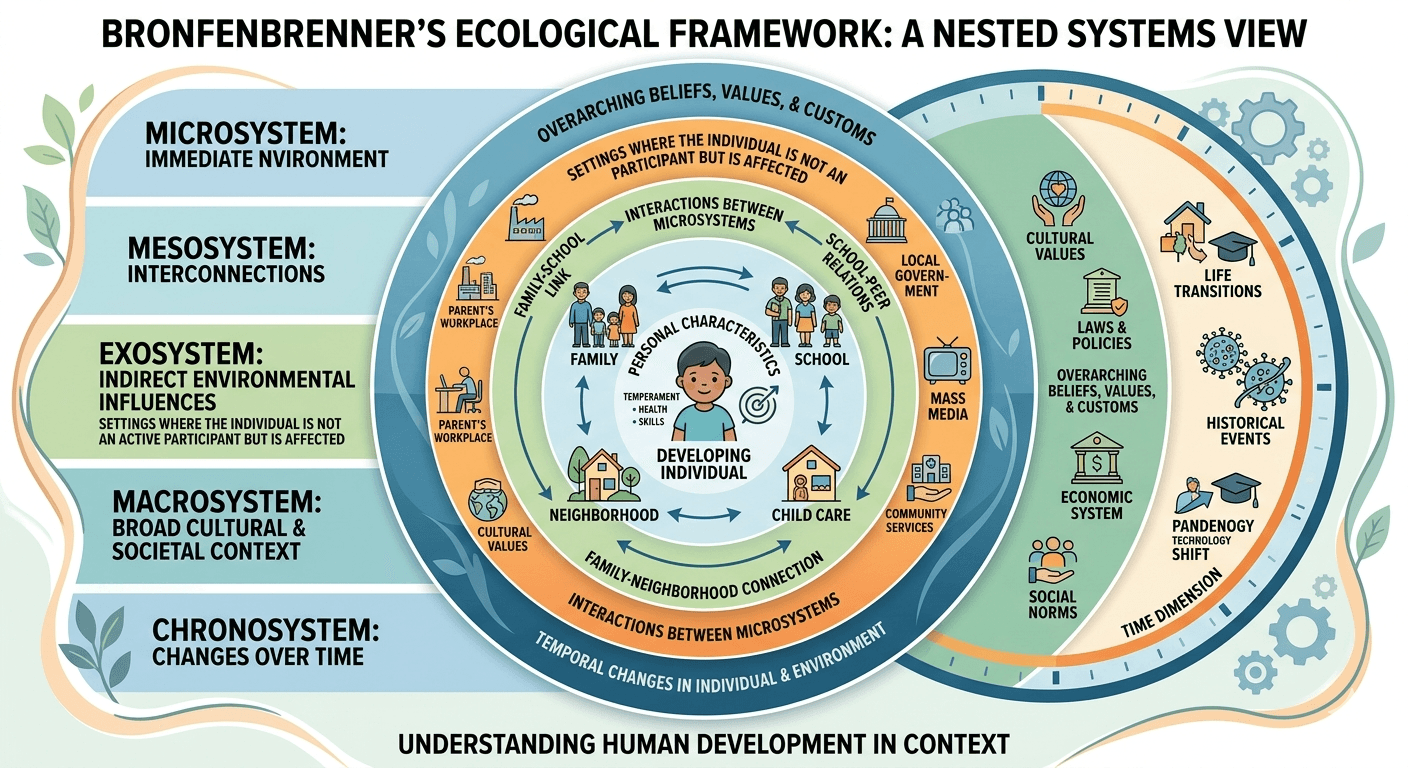
Bronfenbrenner’s Ecological Framework is one of the most widely used models in developmental psychology, education and social policy. Rather than studying individuals in isolation, it asks: what are the systems (such as family, school, community, culture & time) that surround a person and shape who they become?
This primer introduces the five nested systems (Microsystem, Mesosystem, Exosystem, Macrosystem and Chronosystem) in plain language and then applies them to four real-world contexts: university leadership, school education, contemporary Indian family life, and students navigating their own growth.
Developed by Ram Kumar Kakani at RV University, April 2026, with an accompanying slow-reading guide designed to make the ideas connect with lived experience rather than remain as academic abstraction.
The framework explained in pages 3-4 (and simplified in page 13 - see below to download the document) is called "ecological" because it borrows from biology: just as an organism cannot be understood apart from its environment, a person cannot be understood apart from the systems (family, school, culture, time) that surround and shape them. Crucially, the influence runs both ways. You are shaped by your world, and you shape it in return.
To make the reading meaningful (and not just another PDF we skim), I suggest you follow a slow-reading, deep-thinking plan:
Because the document is layered - just like the framework itself. Reading two pages at a time allows the ideas to sink in, settle, and connect with our lived experience.
A shorter treatment of this framework, applied to Indian higher-education reform and NEP 2020, appeared as 'Every Choice Matters' in The Hindu (EducationPlus) on 11 May 2026.
Available Documents & Guides
Bronfenbrenner’s Ecological Framework, in detail
13-page PDF